Diabetic Peripheral Neuropathy Treatment
Helping people with peripheral neuropathy
Every treatment plan is customized based on the cause of your neuropathy, your symptoms and your goals
Patients who complete our programme experience significant clinical improvement
What Is Diabetic Peripheral Neuropathy?

Diabetic peripheral neuropathy is one of the most common complications of diabetes, affecting up to half of people living with the disease.
Persistently elevated blood sugar damages the small blood vessels that nourish the peripheral nerves, reducing their oxygen and nutrient supply.
Over time, this can lead to burning pain, tingling, numbness, weakness and balance problems, most often beginning in the feet and gradually progressing upward.
Although diabetic neuropathy develops slowly, it should never be considered a normal part of aging or something you simply have to accept.
Early assessment and treatment may help preserve nerve function, improve symptoms and reduce the risk of falls, foot ulcers, and other complications.
Recognizing the Signs & Symptoms of Diabetic Peripheral Neuropathy
Diabetic peripheral neuropathy usually develops gradually, often over years and decades. Because symptoms progress slowly, many people don't realize how much nerve function they've lost until it begins interfering with their daily activities.
Common symptoms include:
• Tingling or "pins & needles"
• Numbness that often begins in the toes & gradually spreads upward
• Sharp, stabbing or electric shock-like pain
• Increased sensitivity to touch, where even bedsheets or socks become uncomfortable
• Feet that feel like you're walking on cotton, sand or thick socks
• Poor balance or feeling unsteady when walking
• Symptoms that are worse at night & interfere with sleep
• Reduced ability to feel heat, cold or pain
• Cuts, blisters, or injuries that go unnoticed because of reduced sensation
One of the greatest dangers of diabetic peripheral neuropathy is that as sensation decreases, so does your ability to recognize injuries. A small blister, splinter,
or pressure sore may go unnoticed, increasing the risk of infection, slow wound healing, and foot ulcers. This is one of the reasons regular foot care and early treatment are so important.
Many people assume that when the burning pain fades and numbness takes its place, their neuropathy is improving.
Unfortunately, the opposite is often true. Increasing numbness usually indicates that nerve damage has progressed, making it even more important to assess your nerve health and explore treatment options before further function is lost.
Did You Know?
Loss of protective sensation in the feet is one of the biggest risk factors for diabetic foot ulcers because injuries may go unnoticed until they become infected.
Because diabetic peripheral neuropathy develops gradually, many people don't realize how much sensation they've lost until objective testing reveals it.
Why Does Diabetes Cause Peripheral Neuropathy?
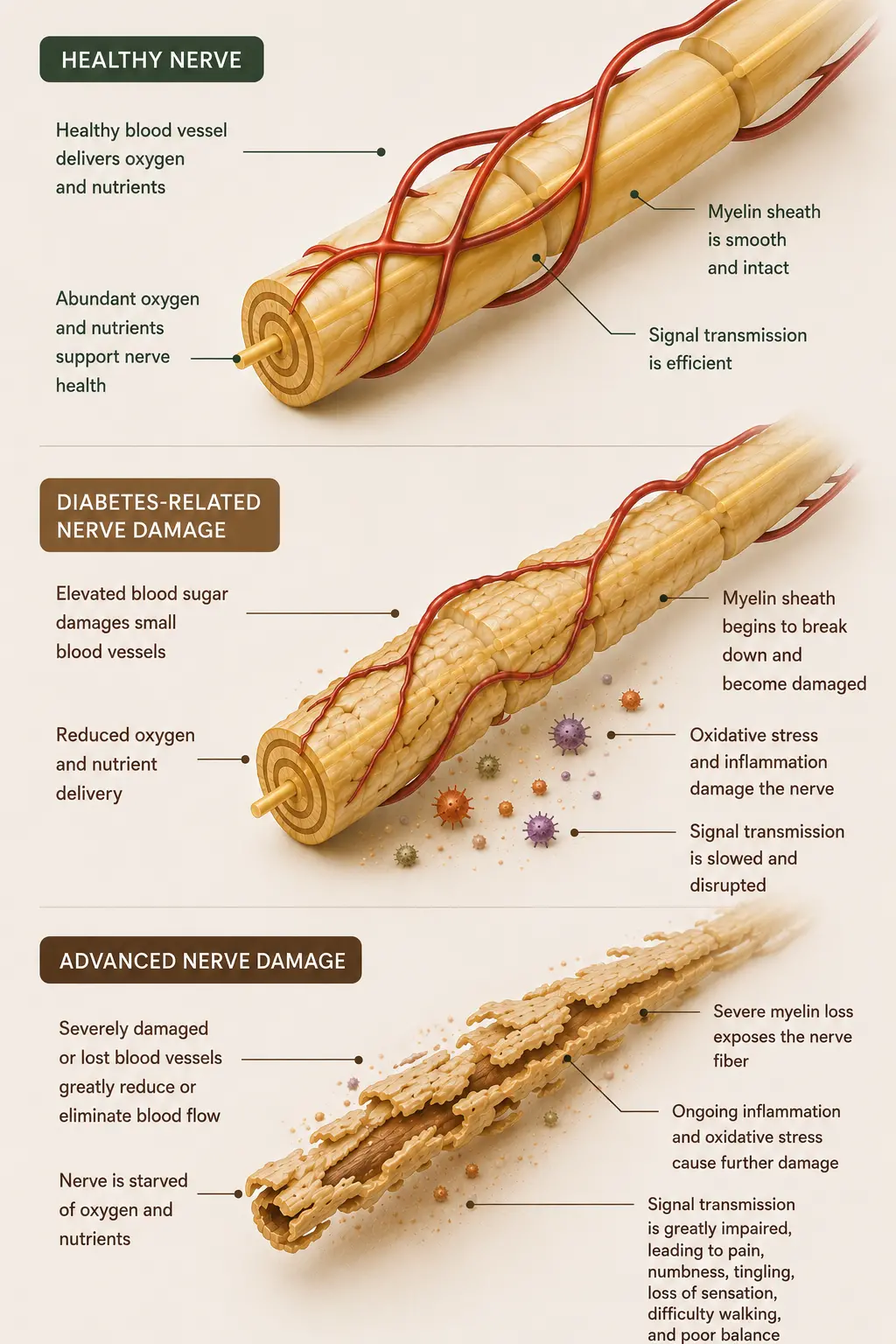
Diabetic peripheral neuropathy develops when elevated blood sugar damages the small blood vessels that supply your peripheral nerves with oxygen and nutrients. Over time, the nerves become less able to function normally, leading to symptoms such as burning pain, tingling, numbness, weakness and balance problems.
High blood sugar also contributes to inflammation and oxidative stress, creating an environment that places additional strain on already vulnerable nerves.
As the damage progresses, nerve signals become weaker or disrupted, making it more difficult for your brain to accurately interpret sensations from your feet and legs.
Maintaining stable blood sugar levels is one of the most important steps in protecting your nerves and supporting long-term nerve health. While blood sugar management alone does not reverse existing nerve damage, it helps slow further progression and creates a healthier environment for nerve repair.
That's why our approach always complements, rather than replaces, the diabetes care you receive from your physician or diabetes specialist.
Patient Case Study: How Bob Regained Confidence After Years of Diabetic Neuropathy

This case study is based on a real patient treated at What's Good - Wellness by Design. The patient's name and identifying details have been changed to protect privacy.
After living with Type 2 diabetes for more than 15 years, Bob had grown accustomed to checking his blood sugar, taking his medications, and watching his diet. What he hadn't expected was the gradual loss of feeling in his feet. It began with tingling in his toes, followed by burning pain that often kept him awake at night. Eventually, the burning faded, replaced by numbness, poor balance, and a heavy sensation in his lower legs that made him feel unsteady on his feet.
An avid golfer and passionate gardener, Bob began giving up the activities he loved. Walking the golf course became exhausting, and standing over the ball long enough to take a comfortable swing became increasingly difficult because he no longer felt stable through his feet and legs. Working in his garden was just as frustrating. Kneeling to plant flowers or pull weeds was one thing, but getting back to his feet became a struggle, leaving him worried about losing his balance or falling.
During his Comprehensive Consultation and Sensory Assessment at What's Good - Wellness by Design, we identified measurable sensory loss consistent with diabetic peripheral neuropathy. After determining that Bob would likely benefit from our care, we developed a personalized treatment plan combining acupuncture, ATP Resonance Frequency Therapy, functional nutrition, and lifestyle recommendations alongside his existing diabetes management.
Over the following months, Bob experienced improvements in both his symptoms and nerve function. As his balance and sensation improved, he felt more confident walking the golf course and was able
to spend longer periods tending to his garden without worrying about every step. Repeat sensory assessments also demonstrated measurable improvements in nerve function throughout his programme.
For Bob, success was getting back onto the golf course and into the garden with confidence, not just the pain relief he experienced. While every patient's situation is unique and no treatment can guarantee results, many people have more potential for improvement than they've been led to believe.
Our Approach to Treating Diabetic Peripheral Neuropathy

At What's Good - Wellness by Design, our goal is to do more than simply manage the symptoms of diabetic peripheral neuropathy. We aim to support healthier nerve function while helping reduce pain, improve sensation, restore balance and preserve your mobility and independence for years to come.
Because ongoing high blood sugar can continue to affect nerve health, maintaining good diabetes management remains an important part of long-term success.
Our treatments are designed to complement, not replace, the care you receive from your diabetes healthcare team.
Every patient begins with a comprehensive consultation and objective sensory assessment to evaluate the extent of nerve damage and determine whether you are likely to benefit from treatment. We then develop a personalized treatment plan based on your symptoms, overall health, blood sugar control, and the severity of your neuropathy.
Based on your assessment, treatment may include acupuncture, ATP Resonance Frequency Therapy, dry needling, infrared and photobiomodulation therapy, Chinese herbal medicine, functional nutrition, and lifestyle recommendations. Rather than relying on a single treatment, we combine evidence-informed therapies that work together to support healthier nerve function through multiple complementary approaches while complementing the care you receive from your physician or diabetes care team.
Throughout your programme, we repeat objective sensory assessments to monitor changes in nerve function over time. This allows us to measure your progress, adjust your treatment plan as needed, and ensure your care continues to align with your goals.
Our comprehensive peripheral neuropathy programme has helped 85% of patients who complete treatment experience meaningful clinical improvement. While every patient's situation is unique and results can never be guaranteed, we'll work with you to set realistic expectations and objectively monitor your progress throughout treatment.
Our goal isn't simply to recommend treatment. It's to help you make an informed decision based on objective findings and realistic expectations.
Finding the Right Treatment Starts with the Right Assessment

Not every case of diabetic peripheral neuropathy is the same, and not every patient will benefit from the same treatment approach. The severity of nerve damage, blood sugar control, your overall health, and how long you've been experiencing symptoms all influence what improvements may be possible.
That's why every patient at What's Good - Wellness by Design begins with a comprehensive consultation and objective sensory assessment before treatment recommendations are made. Our sensory assessment measures how well the nerves in your feet and legs are functioning, allowing us to establish a baseline before treatment begins and objectively monitor changes in nerve function as treatment progresses.
This assessment allows our team to:
• Understand how diabetic peripheral neuropathy is affecting your daily life.
• Measure the extent of sensory loss.
• Determine whether you are likely to benefit from treatment.
• Develop a personalized treatment plan based on your specific needs and goals.
• Objectively track your progress throughout your care.
One of the things that sets our approach apart is our commitment to honesty. If we believe treatment is unlikely to provide meaningful benefit, we'll tell you. If we believe there is potential for improvement, we'll explain what outcomes we believe are realistic and how we'll measure your progress along the way.
Our goal isn't simply to recommend treatment. It's to help you make an informed decision based on objective findings and realistic expectations.
Frequently Asked Questions
Whether diabetic peripheral neuropathy can be reversed depends on the extent of nerve damage and how long it has been present.
While some people experience significant improvements in symptoms and nerve function, others achieve better symptom control and improved quality of life rather than complete recovery.
The sooner nerve damage is addressed, the greater the potential for improvement.
Yes, it may. Many of our patients have been living with diabetic peripheral neuropathy for several years before seeking treatment.
While earlier intervention generally leads to better outcomes, improvements in symptoms and function are still possible for many people.
Your comprehensive consultation and sensory assessment will help us determine whether you're likely to benefit from treatment.
Yes. Persistently elevated blood sugar continues to damage the peripheral nerves, making it more difficult for them to recover.
Maintaining stable blood sugar levels creates a healthier environment for nerve function and complements the treatments you receive at What's Good - Wellness by Design.
Our recommendations are designed to support, not replace, the diabetes care provided by your physician or diabetes care team.
No. Our treatments are designed to complement your existing diabetes management, not replace it.
We encourage patients to continue working closely with their family physician, endocrinologist, diabetes educator and other members of their healthcare team throughout treatment.
Treatment recommendations vary depending on the severity of your neuropathy, the degree of nerve damage, your blood sugar control, and your overall health.
After your initial assessment, we'll provide a personalized treatment recommendation based on your specific situation.
Many patients begin noticing changes within the first several weeks of care.
Many people notice that burning pain and tingling become more intense in the evening or during the night. While the exact reason isn't fully understood, reduced distractions, changes in circulation, and altered nerve signalling may all contribute.
Poor sleep caused by neuropathy can also affect overall health and quality of life, making effective symptom management an important part of treatment.
ATP Resonance Frequency Therapy is one of several integrative therapies we use to help create an environment that supports healthy nerve function and recovery. It delivers targeted electrical frequencies designed to support cellular function and reduce inflammation.
At What's Good - Wellness by Design, it is used alongside acupuncture and other evidence-informed integrative therapies as part of a comprehensive treatment plan tailored to your individual needs.
Acupuncture is covered under many extended health benefit plans, although coverage varies between providers and policies. We recommend checking your individual plan for details.
Your Initial Comprehensive Consultation and Sensory Assessment is $47 (regularly $100).
Take the First Step Toward Better Nerve Health
Living with diabetic peripheral neuropathy doesn't mean you have to simply accept burning pain, numbness or the fear of losing your independence.
The first step is understanding the extent of your nerve damage and whether treatment is the right option for you.
During your Comprehensive Consultation and Sensory Assessment, we'll evaluate your nerve function, review your symptoms and medical history and determine whether you are likely to benefit from treatment in our peripheral neuropathy programme. If treatment is appropriate, we'll explain what improvements may be possible and develop a personalized treatment plan tailored to your individual needs.
Book your Comprehensive Consultation and Sensory Assessment today and discover what's possible.